



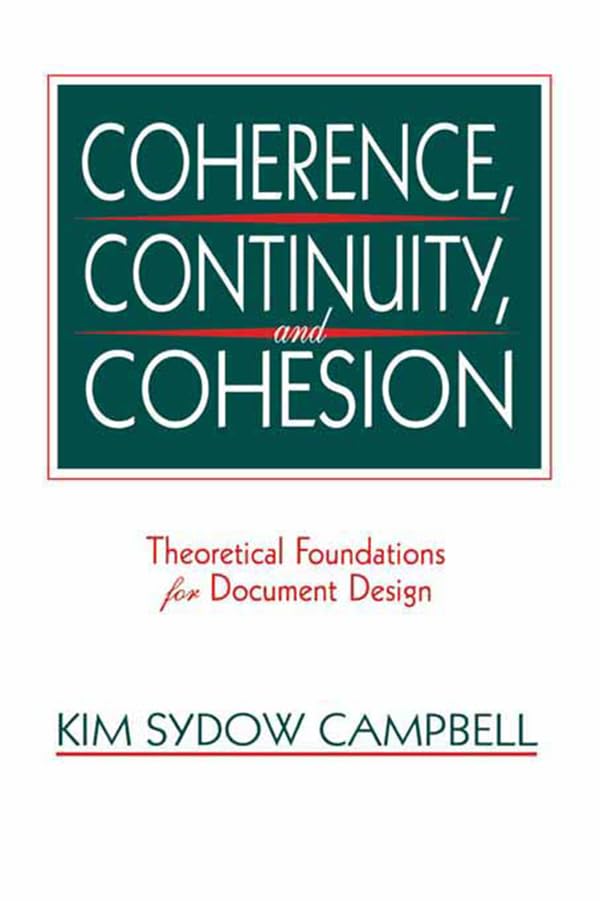
Coherence, Continuity, and Cohesion: Theoretical Foundations for Document Design (Routledge Communication Series)

 4.4 (62 items)
 Limited Time Sale
US$26.04 cheaper than the new price!!
Free cash-on-delivery fees for purchases over $99
Product details
| Management number | 231941665 | Release Date | 2026/06/18 | List Price | US$17.36 | Model Number | 231941665 | ||
|---|---|---|---|---|---|---|---|---|---|
| Category | |||||||||
There is a need for general theoretical principles describing/explaining effective design -- those which demonstrate "unity" and enhance comprehension and usability. Theories of cohesion from linguistics and of comprehension in psychology are likely sources of such general principles. Unfortunately, linguistic approaches to discourse unity have focused exclusively on semantic elements such as synonymy or anaphora, and have ignored other linguistic elements such as syntactic parallelism and phonological alliteration. They have also overlooked the non-linguistic elements -- visual factors such as typography or color, and auditory components such as pitch or duration. In addition, linguistic approaches have met with criticism because they have failed to explain the relationship between semantic cohesive elements and coherence. On the other hand, psychological approaches to discourse comprehension have considered the impact of a wider range of discourse elements -- typographical cuing of key terms to enhance comprehension -- but have failed to provide general theoretical explanations for such observations. This volume uses Gestalt theory to provide general principles for predicting one aspect of coherence -- that of continuity -- across the entire range of discourse elements, and also to outline the relationship between cohesion and coherence. The theoretical core of this book argues that the cognitive principles that explain why humans "sense" unity in a succession of sounds (a whole musical piece) or in a configuration of visual shapes (a complete object) are the basis of principles which explain why we "sense" unity in oral, written, and electronically produced documents. Read more
| ASIN | B0CTBGS7KB |
|---|---|
| XRay | Not Enabled |
| ISBN13 | 978-1136689154 |
| Edition | 1st |
| Language | English |
| File size | 3.3 MB |
| Page Flip | Enabled |
| Publisher | Routledge |
| Word Wise | Not Enabled |
| Print length | 123 pages |
| Accessibility | Learn more |
| Part of series | Routledge Communication |
| Publication date | October 18, 2013 |
| Enhanced typesetting | Enabled |
Bestseller ranking
General



![Warped Away Travel Guide To Cambridge England: The Complete Visitor's Companion for an Unforgettable Experiences (Whispers of Europe Travel Guide) [Print Replica] Kindle Edition](https://m.media-amazon.com/images/I/91OAD9oqPKL._SL1500_.jpg)
Customers who viewed this product also viewed
Criticism


![Der Diskurs um ›Wildnis‹: Von mythischen Wäldern, malerischen Orten und dynamischer Natur (Edition Kulturwissenschaft 185) (German Edition) [Print Replica] Kindle Edition](https://m.media-amazon.com/images/I/81y8I7EFeaL._SL1500_.jpg)
Correction of product information
If you notice any omissions or errors in the product information on this page, please use the correction request form below.
Correction Request Form